

Your friends calls you after a tough day perhaps they have just been fired from their job, or failed an important test, or they have lost someone close to them. And while you wish to offer the appropriate comfort, you hesitate because you do not know whether you should be empathic or sympathetic. The reason for your hesitation is quite understandable, as the empathy vs sympathy can constantly wage war in your head, making you confused between the two in everyday speech.
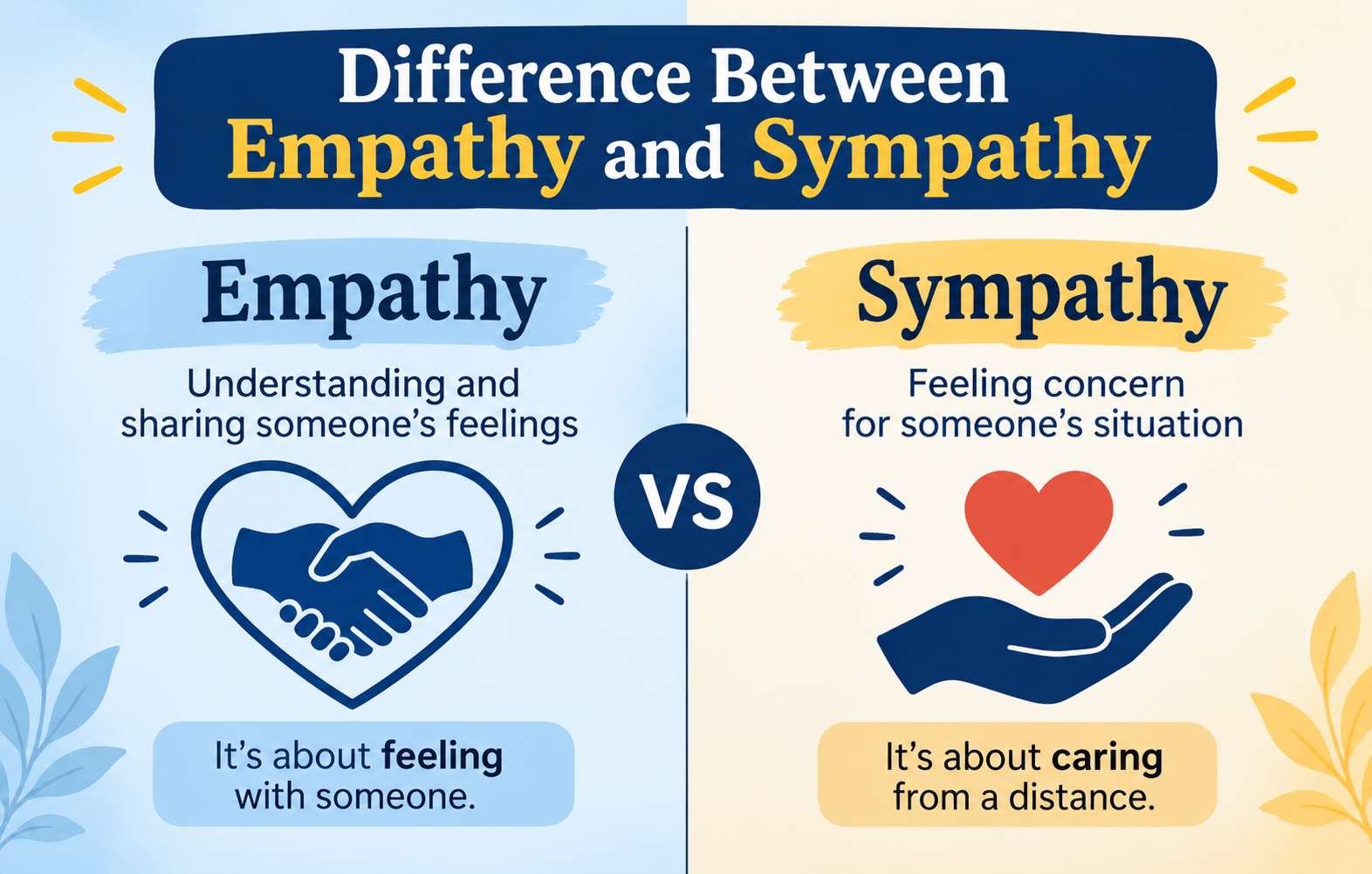
In brief, empathy refers to the attempt to understand someone’s feelings from their perspective and possibly even feeling the emotion yourself. While sympathy refers to concern or sorrow for the other person due to their situation. Both concepts are related to each other, but different nevertheless. Take a look at what these terms mean and how they are used in conversation.
What Does Empathy Mean?
Empathy refers to the ability to understand the emotions or perspectives of another individual from his or her perspective. In psychology and philosophy, this concept includes various capabilities such as knowing how someone feels, getting engaged emotionally and even sharing someone’s emotions at times. The definition of empathy does not involve mere guesses about someone’s emotions but the ability to focus on the situation of another person and to try understanding it.
There are two main types of empathy usually considered. Understanding the point of view of another person is referred to as cognitive empathy, while having a reaction to it that is an emotion is known as emotional empathy. From the perspective of OECD, empathy is multi-dimensional, including not only emotional skills but cognitive skills as well, hence the varying experiences people have when empathizing.
An example of this problem would be your friend being in a depressed mood due to having failed an important exam. While you do not immediately give any piece of advice, you carefully listen to your friend, compliment him or her on the effort put forth, and explain the reason for pain.
What Does Sympathy Mean?
In essence, sympathy entails the feeling of sorrow and understanding for an individual facing some kind of hardship. You acknowledge the person in pain without necessarily having experienced their hardships.
A sympathetic reaction includes sending a text or embracing another individual while saying, “Sorry about what you’re going through.” The actions are important as they express the sentiment of seeing what the other individual is experiencing and caring about it. The act of sympathizing is quite different from pity since it may be an appropriate reaction in some cases.
Consider your colleague being let go of work and deciding to console him in that way, “Sorry about what’s happening to you. I hope it all becomes okay soon.” You don’t necessarily have to be aware of the pain the individual is in but you can appreciate the challenge he’s facing.
What Is the Difference Between Empathy vs Sympathy?
Empathy versus sympathy all depends on where you focus your attention. For an empathic response, you focus on understanding their inner feelings. However, for sympathy, you respond to the realization that they are going through something hard. Both responses can be caring but none of them is always right.
| Comparison | Empathy | Sympathy |
| Core idea | Understanding or sharing another person’s emotional experience | Feeling concern or sorrow for their situation |
| Where the focus goes | Their perspective and feelings | Their hardship and well-being |
| Emotional connection | May involve a similar feeling | Does not require feeling the same thing |
| Typical response | “I can see why this has been so hard for you.” | “I’m sorry this happened to you.” |
Imagine the following: Empathy focuses on letting others know what you think and feel while sympathy just cares about how they feel. These reactions don’t have to replace each other at any time.
Real-Life Examples of Empathy and Sympathy
The most important thing here is seeing the same situation from different perspectives. In this case, you’ll understand the meaning of empathy vs sympathy examples much better than if you just memorized some phrases.
A Friend After a Breakup
Your buddy has just broken up after an extended time period and is feeling helpless and confused. You may say, “I’m sorry that this happened to you. Breakups are tough,” as a sympathizing response.
“I understand that you have invested so much of yourself into this relationship, and I know how much that must hurt.” It allows them to speak about their problem and understand what they are going through.
For a Student With Poor Grade
Student performs poorly despite putting in so much effort into preparing for exams for the past several weeks. A sympathizing response could be, “I am sorry that you were not able to secure the desired score.”
“I understand how tough this experience can be because of the amount of work you put in to prepare for the exams.”
Someone Grieving a Family Member
In cases where one loses a family member, the sympathetic response is likely to be “I am sorry for your loss.” This is not only appropriate but respectful too.
An empathic response can be, “I cannot imagine how burdensome that is for you, but if you need someone to talk to, I am here.” Here lies the link between empathy and sympathy examples, since both are important during times of sorrow.
How Are Empathy, Sympathy, and Compassion Different?
The three terms are linked but not interchangeable, as “Empathy” refers to an understanding of the emotions felt by someone else. “Sympathy” is the concern for or pity on that person. Compassion means feeling sympathy but also having the wish to help alleviate their pain.
According to the Stanford Encyclopedia of Philosophy, sympathy refers to concern for the well-being of others, while compassion is sympathy towards severe pain.
| Concept | What It Looks Like | Example |
| Empathy | Understanding their perspective | “I can see why this feels overwhelming.” |
| Sympathy | Feeling concern for them | “I’m sorry you’re dealing with this.” |
| Compassion | Wanting to help | “Would it help if I brought you dinner tomorrow?” |
In case your friend is having a hard time, you may understand why he or she feels exhausted, feel sorry for their condition, and then be ready to help with something practical. All these responses occur simultaneously.
Is Empathy Better Than Sympathy?
False as empathy shows a person that they are understood and are not alone while sympathy shows a person that they are cared for. The one that is helpful will vary by person, by situation and by the kind of help they need.
There are some people who want to talk about what happened to them, and there are others who simply want their voice to be heard and without being offered any solutions. Sympathy is not the same as empathy meaning, but that is a mistake in accepting that anything but genuineness is inferior.
How Can You Show Empathy and Express Sympathy?
Empathetic communication entails listening attentively without making interruptions. It’s advisable that they ask open-ended questions, like “How has the experience been for you?” rather than make guesses about how that individual is feeling.
In sympathetic communication, one should express acknowledgment for the hardship and then comfort him in their own style. Phrases like “it could have been worse” shouldn’t be used since it will make him shut down.