

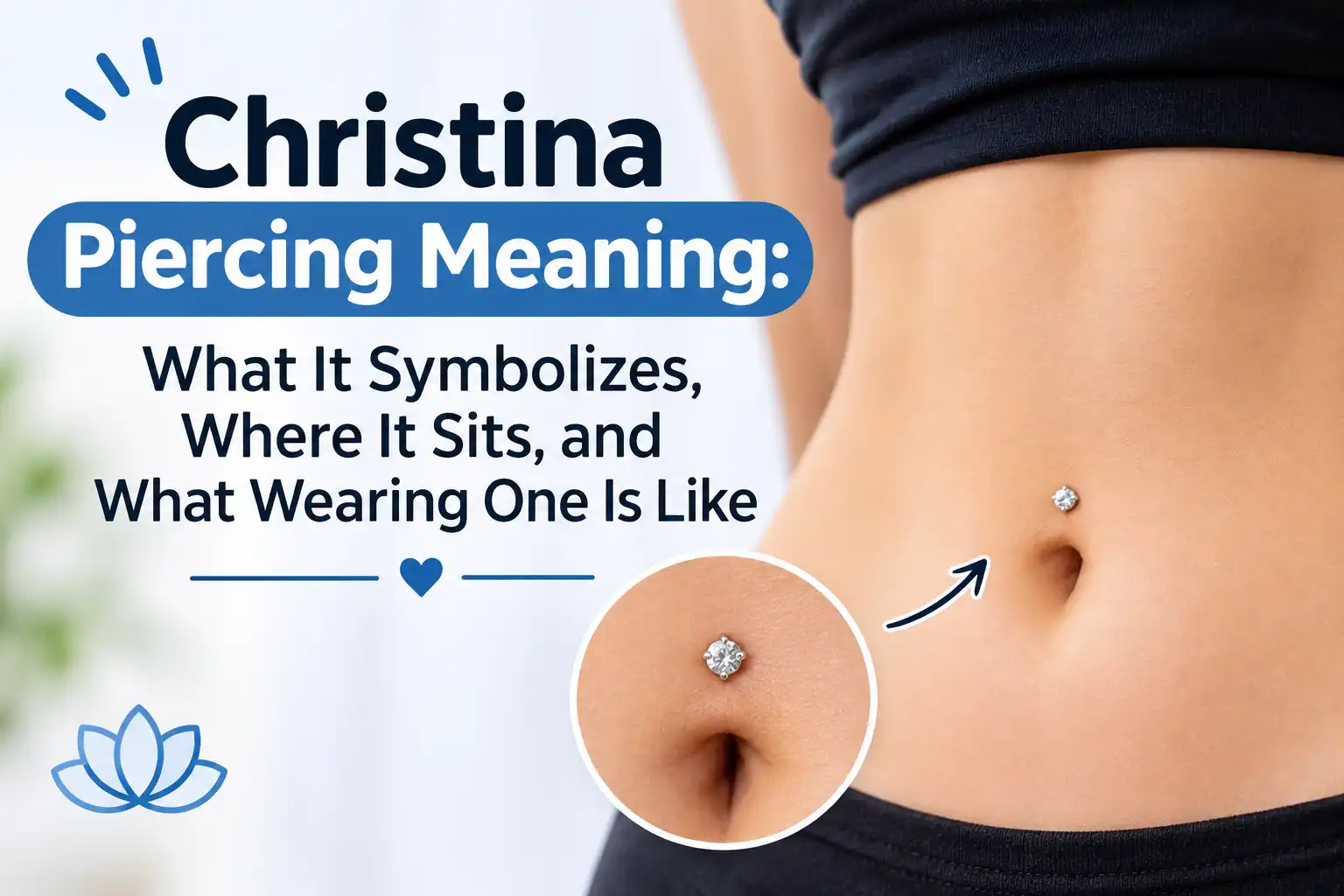
Christina’s piercing symbolism has an individual meaning that can be associated with confidence, self-expression, and ownership of one’s own body. It is done on a vertical surface piercing that is performed in the place where the outer labia come together under the pubic mound.
The jewelry is positioned above the vulva zone and hence is not visible under clothing but only when it is taken off. Still, there are many doubts in one‘s mind related to the Christina piercing’s meaning and location. So, with that in mind, this guide describes symbolism, pain, healing, jewellery, aftercare, and the safety process.
Where the Christina Piercing Sits
It is done at the top of the vagina, where the outer lips join just below the pubic mound. With a surface piercing, and so on, the jewelry used does not go through any natural fold or opening but only through a tunnel of flesh.
In this process, two holes are made by the piercer, and a barbell or surface bar is placed between the two. So, the lower end of this jewelry rests at the top of the vagina, while the upper end, that is the decorative end, rests on the pubic mound.
The piercing site does not involve the clitoris, urethra, and vagina. Also, the pressure can cause discomfort at times.
Quick Facts
| Feature | Detail |
| Type | Vertical surface piercing |
| Placement | Where the outer labia meet, below the pubic mound |
| Jewelry | Custom curved barbell or surface bar |
| Visibility | Upper end is visible above the pubic mound |
| Anatomy | Depends on having enough tissue for a safe channel |
Why Anatomy Matters
Anatomy determines whether it is a right type of piercing for your body; it is vital that the tissue is deep enough and can withstand it. However, if the Christina piercing location is too close for pinching, you should think about this piercing as not worth doing.
The assessment of an experienced piercer should come first before any appointment. This will help avoid such unwanted results as incorrect placement and premature rejection.
What a Christina Piercing Means to the People Who Wear It
Meaning of the Christina piercing in a woman can be personal, and there is no universal code for the same. For many who get the piercing, it is a sign of confidence and body autonomy, and the freedom to take a decision regarding their own body.
For some people, it is a mode of expression, like getting a tattoo, choosing a hairstyle, or other kind of body modification.
Confidence and Body Ownership
For others, the piercing symbolizes ownership of the body and the sense of feeling more connected with it. It can serve as an understated reminder of the fact that the person has the right over his/her body.
Meaning of Christina Piercing Female As Meaningful Event or Recovery Period.
The Christina piercing meaning female can also have connotations of marking an important event, recovery after some hard times and starting a new stage in life. So, the meaning is highly individual and no one should impose any kind of deeper meaning on this piercing.
Aesthetic and Private Adornment
Another reason for getting this piercing is aesthetic reasons. In addition to its functional meaning, the piercing will also look nice with its little decoration under clothes.
Besides, this is also a form of private adornment as the piercing is made for the owner rather than for the outside world. Many people are happy to have such a private and significant thing.
What It Does Not Mean
Piercing is a decoration in the first place, and it is not sensations that drive most people to pierce their body parts. Contrary to some genital piercings, Christina piercing will not enhance sexual sensation and will be felt uncomfortable with any kind of pressure put upon it.
There is no one meaning shared by all the wearers, and it becomes the attraction of the piercing itself. The correct answer here would be that the Christina piercing meaning depends on who wears it and why they did.
How Its Name and Reputation Came About
This piercing is also referred to as a Venus piercing due to its position near the pubic mound. The term Christina is also associated with this kind of body piercing. There is no strong evidence that this piercing originated from an ancient rite, culture, or symbol.
It cannot be concluded that there is any strong evidence of this kind of body piercing originating from an ancient ritual, culture, or symbol. It is considered to be a body-piercing style in the modern world.
Why It Became More Known
The increased popularity of body piercing in the fashion world and social media caused the Christina piercing to move out of its small circles. Greater awareness has been accompanied by more talk on such topics as anatomy, healing, high-quality jewelry, and the need to find a qualified practitioner.
This style gained popularity due to the fact that it is surface piercing and got its bad reputation of being beautiful yet complicated. And the reputation is deserved, since the surface piercings are more difficult to place due to the risk of migration and rejection.
Pain, Healing Time, and What to Expect
Pain differs from individual to individual; however, most people report that pain is sharp and then comes pressure. It depends on one’s anatomy, nervousness, stress levels, technique of the piercer, and tolerance to short-term pain.
The site might be sore, swollen, and warm for a few days after the procedure. Light bleeding, bruises, and a little whitish fluid might also occur during the initial healing stage.
Healing Timeline
The healing time is usually measured in months, ranging from two to four months on average. But healing will take more time when there is skin irritation caused by clothes, ill-fitting jewelry, or poor aftercare.
With the long tunnel, constant movement, and friction caused by clothes are some of the reasons why a Christina piercing may be more challenging compared to other ear and facial piercings.
Risks to Understand
Being a surface piercing, the risk of migration or rejection will be higher compared to many other piercing methods. By migration, we mean gradual moving of the jewelry while rejection implies slow pushing of jewelry by your body towards the skin.
You should consult a piercer about your concerns if your holes start moving or your skin bridge becomes narrower, your bar starts appearing more or one end sinks into the tissue. It may help you prevent any further problems but sometimes a piercing can only be removed.
The healing process takes time, and the fact that a piercing feels good doesn’t mean it is completely healed. Leave the original jewelry on until the piercing is fully healed by a piercer.
Jewelry That Works and Jewelry to Skip
The proper Christina piercing jewelry must aid in healing and not irritate the tissues or cause extra pressure on them. With initial jewelry that is used for the piercing is normally a customized curved barbell or a surface bar that is picked by the piercer.
Best Jewelry Materials
| Material | Why people choose it | Best for |
| Implant-grade titanium | Lightweight, durable, and suitable for sensitive skin | Initial healing and long-term wear |
| Solid 14k or higher gold | Offers a classic look and can suit some sensitive skin | Healed piercings and decorative ends |
| Niobium | Hypoallergenic option with a darker, matte appearance | People who prefer alternative metals |
| Cheap plated jewelry | Low cost and widely available | Not recommended for a new piercing |
The most preferred type of material is implant-grade titanium because it is resilient, lightweight, and easily tolerated by people with sensitive skin. Jewelry that is made from solid gold and has a minimum of 14 karats without nickel can also be used.
Jewelry Styles to Avoid
One should avoid using jewelry made out of uncertain types of metals, plating, and any jewelry with sharp edges. Low quality jewelry will only increase irritation and will also make it difficult to identify the cause of the reaction.
Decorations such as balls, gems, or even flat discs can be used, but jewelry in its earliest form should be kept plain. Any bulky decoration will just lead to friction.
When to Change Jewelry
Do not exchange jewelry too soon even if the piercing seems to be healed. Piercings heal outwards, and so there is still the possibility that your piercing may not have fully healed even if the entry points look good.
Allow the piercer to select the first jewelry size and type according to your body’s needs. This will help ensure that your piercing is well-fitted and has the least amount of movement possible.
Looking After It: A Practical Aftercare Routine
Effective aftercare involves ensuring that the piercing is kept clean, dry, and free of friction. Wash your hands before touching the piercing and clean the area gently using a sterile saline solution made for wounds.
Daily Cleaning Routine
- Wash your hands before touching the piercing or the area around the piercing.
- Use sterile saline meant for wounds and not contact-lens saline, eye drops, or home-made solutions.
- Gently rinse once or twice a day and dry the area with a clean disposable material.
- Use something other than cloth towels, as they tend to have bacteria and may catch on the jewelry while drying.
- Avoid twisting and rotating the jewelry since this may irritate the healing tissues and push debris into the channel.
The Association of Professional Piercers recommends sterile isotonic saline with 0.9 percent sodium chloride with no additional ingredients. Avoid strong products like hydrogen peroxide, iodine, alcohol, antibacterial soaps, and perfumed creams.
Clothing and Lifestyle
Loose-fitting and breathable clothing is recommended throughout the early stage of healing, particularly if one spends a lot of time sitting down or exercising. Waistbands, coarse materials, and constant pressure could cause irritation and delay the healing process.
Activities that involve direct friction on the pierced site should be avoided until the piercing has been established. These include tight leggings, intense workouts, biking, and clothes that put pressure on the pubic mound.
When to Seek Medical Care
However, minor levels of redness, tenderness, swelling, and crusts might occur during early stages of healing. In addition, some fluid is normal, although, again, it must not be very thick and must not have a foul odor, nor can it be green.
In case of any of the following problems, visit your doctor as soon as possible: spreading redness, heat, increased pain, fever, red streaks near the wound, or thick fluid in yellow, green, or gray color.
Finding a Piercer You Can Trust
Pick a licensed studio that has a good environment, sterilizing process, and helpful personnel when you have queries. The ideal piercer must be able to tell you all about the process and then ask for your consent.
Inquire about the use of disposable needles, body jewelry from high-quality material, and an effective sterile setup. All these things should matter since a sterile process decreases the likelihood of infections.
What to Check Before Booking
- Licensing and Cleanliness: Choose a studio where there is a clearly practiced policy of hygiene and sterilization.
- Disposable Sterile Needles: Check to see if a new, unused needle is used on each client.
- Implant-Grade Jewelry: Make sure that the first jewelry is appropriate for a new piercing.
- Straightforward Anatomy Evaluation: A good piercer will have to refuse if the location is not feasible.
- Portfolio of Healed Piercings: Try to find examples where the same type of anatomy was pierced before.
Any professional must never force you to have a piercing that doesn’t complement your body. Being a member of a professional piercing association might be beneficial, but it cannot replace your doubts and queries.
Is It Right for You? A Quick Self-Check
You may consider getting a Christina piercing if you are fine with the prolonged healing process and can avoid any type of friction throughout this period. You should also be ready for the chance that your anatomy will not allow this piercing at all.
Questions to Ask Yourself
- Am I ready to spend several months on aftercare?
- Am I able to avoid tight clothes, friction, and pressure while healing?
- Am I ready for the chance of rejection or migration?
- Am I doing this for myself or because of some external pressure?
- Is it confirmed by a professional piercer that my anatomy is acceptable?
Choosing Christina piercing should be your decision based only on your feelings. Do not choose it under the influence of your partner or because of social media. It should be your own decision.
Christina piercing can be a good way of self-expression, but it requires proper understanding of everything and reasonable expectations. This is what makes this kind of piercing the right choice for you.
Read More Our Latest Blog: IMO Meaning in Text