

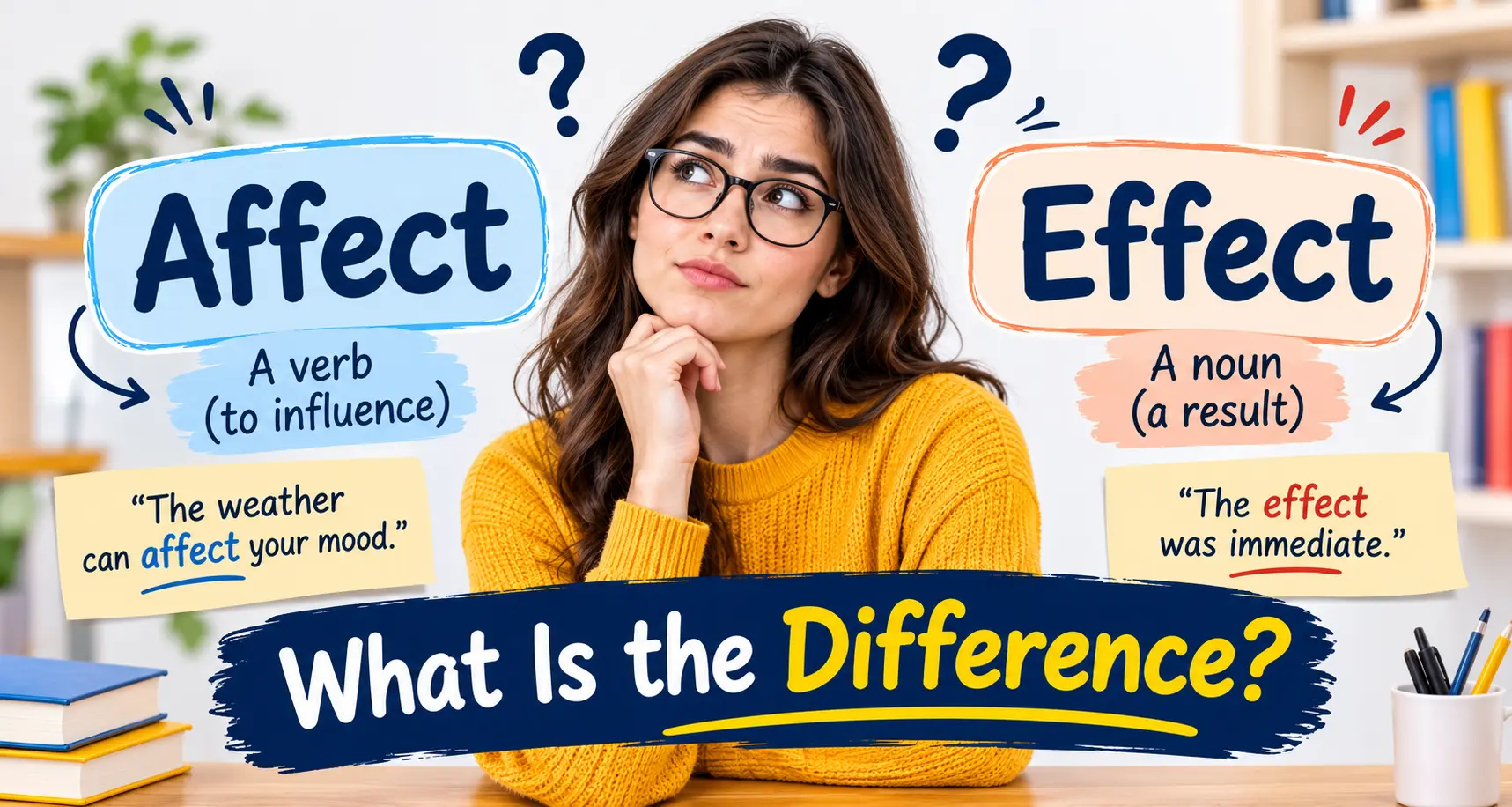
Your searching spree for affect vs effect led you here, and the chances are high you are in the middle of writing something. Now you want to make sure that you will not need to search this again and know exactly the difference to eliminate all your confusion regarding whether to use effect or affect. It is really important for you, as your spellchecker will not catch this mistake.
Hence, to fix it immediately, look at the role the word plays in your sentence.
- Affect is a verb that means to influence something, and you can remember it with the word: Action.
- Effect is a noun that refers to the final outcome, and you can remember it with the word: End of Result.
You do not need a dense grammar lecture to get it right every time. You must have been tired of opening a new search tab every time you write these words. So, below, you will find a five-second swap test to double-check your exact sentence, clear real-world examples, and the two rare exceptions you actually need to watch out for.
What Does “Affect” Mean?
You could use affect (verb). It is a transitive verb, meaning it calls for an object; in other words, you affect somebody or something. The Cambridge Dictionary defines affect simply as to act on somebody or something and change them. So, if you need an action verb meaning to have an impact on somebody or something, then affect is probably the word you need.
- Weather: The heavy rain will affect our outdoor wedding plans.
- Workplace: Lack of sleep can negatively affect your focus during meetings.
- Emotion: The sad movie deeply affected everyone in the theater.
Do a quick substitution: Try replacing affect with the verb influence; if it fits, then you probably want affect. The rain example becomes “the heavy rain will influence our wedding plans, ” which reads just fine.
What Does “Effect” Mean?
Usually a noun, effect denotes a thing or result brought about by another. Dictionaries generally define it as a thing that results from something being done or occurring. An easy test is to see if the word is immediately preceded by an article (an, a, the) or an adjective (positive, lasting). If so, the word you want is almost certainly effect instead of affect.
- Environment: One effect of the heavy rainfall was a flooded garden.
- Employment: One positive effect of working from home is saving the time spent commuting.
- Expressions: Cause and effect, sound effects, side effects.
These are all examples of effect as a noun indicating a result you can point to.
Why These Words Get Mixed Up
This is because when spoken in English, these two words join together as they both begin with an unstressed vowel and are nearly identical. The spelling doesn’t really help either, as there is just one difference between them, which is their starting letter. Even more sadly, the words can even switch roles under certain circumstances, thus breaking what seemed like a hard and fast rule.
How to Remember the Difference Between Affect and Effect
One is a commonly used mnemonic to help, used in several centres including here at the University of Idaho; it is, RAVEN. Look at the letters, read through them, and you have a handy little rule: Remember Affect is a Verb, Effect is a Noun. Experiment with the following sentence: Budget cuts will _________ each department. Affect works well with RAVEN’s question, ‘What is the verb here? It might be easier to remember the difference by linking the initial letter with its corresponding meaning.
The prefix for affect is A, whereas the prefix for effect is E, indicating End. When your confidence wanes, these two mnemonics are useful.
Affect vs Effect: Key Differences at a Glance
It is possible to scan the entire rule in about 5 seconds, even from a phone, in this table. Each line contains one word and its part of speech, definition, and a realistic sentence. Mark it for future use when effect vs affect trips up a draft.
| Word | Part of Speech | Core Meaning | Example Sentence |
| Affect | Verb (usually) | To influence or change | Constant stress can affect your sleep quality over several weeks. |
| Effect | Noun (usually) | A result or outcome | Constant stress can have a harmful effect on your sleep quality. |
| Affect | Noun (rare) | Visible emotional expression | The patient’s affect appeared flat during the entire evaluation. |
| Effect | Verb (rare) | To bring about | Regulators moved quickly to effect a full recall of the product. |
Memorize the first two rows, and you’ll handle most writing situations. The remaining rows cover the difference between affect and effect in formal or specialized contexts.
Common Mistakes and Rare Exceptions
Mistake: Using Effect as an Action Word
Writers often reach for effect when they need a verb, and the sentence quietly breaks.
- Incorrect: Loud construction noise effects my concentration every afternoon.
- Correct: Loud construction noise affects my concentration every afternoon.
Swap in influences, and the sentence works, which tells you the writer needed affects. A quick check like this settles when to use affect vs effect under deadline pressure.
Exception 1: When Effect Is a Verb
As a verb, in formal writing, effect signifies to bring about or accomplish a task. The M.L.A. Style Center gives “to effect change” as the accepted example. The new director hopes to effect change by reorganizing the support staff. Here, effect means bring about; because of this, the director is effecting change, not just affecting it. The convention can sometimes be inverted in more elevated prose, so pause when you come upon it.
Exception 2: When Affect Is a Noun
As a noun, affect in psychology means the outward expression of someone’s emotion. Clinically, a therapist might note that someone has a blunted affect if the individual showed little emotional expression while speaking. You probably will seldom if ever need this sense of the word outside of its specialist setting.
Exception 3: Personal Effects
When you see it in the plural, “effects” can signify personal items or property; this is common in legal contexts and when hospitals or the police complete paperwork. This meaning exists only in the plural, so there’s no need to get tangled up in effect versus affect in this context. A form might ask you to pick up your personal effects before you leave the premises.
Common Phrases and Pairs Worth Memorizing
Certain phrases lock one word in place, and learning them saves you from rethinking every sentence.
- Negatively affect and positively affect: both use the verb, so affect stays.
- Cause and effect, side effects, and special effects: all noun phrases, so effect wins.
- In effect and take effect: both use effect as a noun, even though they sound like actions.
Each pair above works as a ready-made rule you can apply without thinking. Memorizing pairs like these beats re-deriving affect vs effect examples from scratch every single time.
A Ten-Second Check Before You Hit Send
Run through these four steps whenever you hit a doubtful spot in a draft.
- If the sentence needs an action, use affect and test it by swapping in influence.
- If the word follows the, a, an, or an adjective, it’s almost certainly effect.
- If you mean to bring about change, effect is the verb, but double-check that you really mean it.
- If you’re still unsure, rewrite the sentence using influence or result and skip the problem entirely.
Running these checks takes only seconds and beats guessing in a rush. With practice, you’ll know when to use affect vs effect without running any steps at all.
Test Yourself: Five Quick Sentences
Pick the right word for each blank, then check your answers below the list.
- Construction delays will ___ our arrival time this evening.
- The medicine had a calming ___ on the patient.
- Voters hope the new law will ___ lasting change.
- Strong coffee doesn’t ___ me the way it used to.
- The new policy goes into ___ on Monday.
Here are the answers, in sequence: affect, effect, effect, affect, and effect. Number three is a trick one, as effect can also be a verb, meaning to bring about, so not recognising it is perfectly normal. For a truer gauge of your affect vs effect instinct, score yourself on the other four.
Final Thoughts
That’s a wrap on everything you need to get affect vs effect right every time. Simply ask if the word you need is doing something or being the result of something, and your answer will be almost instant. The final touch on affect vs. effect is to remember its various uses, whether it be effecting change, flat affect, or personal effects.
FAQs
Is affect a verb or a noun?
Generally speaking, affect is mostly used as a verb and means to influence or have an impact on. It is seldom used as a noun, except in the field of psychology, where it refers to a person’s observed and immediate display of emotion, e. g., a flat or blunted affect.
Is effect a verb or a noun?
Effect is predominantly a noun, which means a result or outcome. In formal contexts, it can also be a verb meaning to bring about, as in to effect change. Identifying this exception early will make choosing between effect and affect much easier.
How do you use affect and effect in the same sentence?
One common instance of this is: stress can affect your sleep, and poor sleep can affect a long-term change in your mood. Notice how affect is the verb here while effect is the noun.
What is an easy way to remember affect vs. effect?
Try the acronym RAVEN: Recall Affect is a Verb, Effect is a Noun. If that’s too stiff, think of Affect as Action and Effect as an End result. Both mnemonics take just a few seconds to apply and are right in practically every context.